
What Is a POLST Form? End-of-Life Orders Explained
A POLST form converts a seriously ill patient's end-of-life wishes into binding medical orders. Here's how it works and who needs one.
Published · Updated
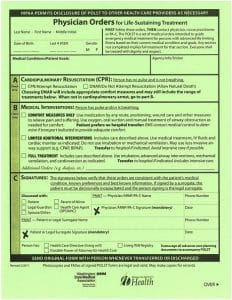
A POLST form - short for Physician Orders for Life-Sustaining Treatment - is a brightly colored medical order that tells paramedics, ER doctors, and nursing staff exactly which treatments a seriously ill patient does or does not want in an emergency. Unlike a living will, a POLST is signed by a clinician and is legally binding across every care setting. If your parent has advanced dementia, late-stage cancer, severe heart failure, or another life-limiting illness, completing a POLST with their doctor is one of the most concrete ways to protect their wishes.
Below you'll find what the form covers, how it differs from an advance directive, and a step-by-step process for completing one. If you're also organizing legal paperwork, start with our guide on How to Find the Right Power of Attorney Lawyer - most families need both documents at the same time.
What exactly is a POLST form?
A POLST is a portable medical order, signed by both the patient (or their authorized surrogate) and a clinician - a physician, nurse practitioner, or physician assistant. It translates a person's care preferences into specific, actionable orders for first responders and hospital staff: whether to attempt CPR, whether to transfer to the ICU, whether to use a ventilator, antibiotics, or a feeding tube.
The form was created in Oregon in 1991 and is now used, under varying names, in nearly every U.S. state (National POLST Collaborative, 2024). It is printed on vivid pink, green, or yellow paper so emergency personnel can spot it on a refrigerator, bedside table, or medical chart within seconds.
Who actually needs a POLST?
A POLST is not for healthy adults. It is designed for people whose clinician would not be surprised if they died within the next 12 months - patients with advanced frailty, terminal illness, or progressive conditions like late-stage Alzheimer's or COPD. Roughly 1 in 9 Americans aged 65 and older is living with Alzheimer's dementia (Alzheimer's Association, 2024), and for those in the final stages, a POLST helps prevent unwanted hospitalizations and intubations.
Healthy adults should instead complete an advance directive or living will (National Institute on Aging, 2023), which speaks to hypothetical future scenarios rather than current medical orders.
Two scenarios where a POLST changes the outcome
- Example 1: An 87-year-old woman with advanced dementia in an assisted living community chokes during dinner. Without a POLST, paramedics would attempt full CPR and intubation. With a POLST marked "Comfort Measures Only," staff can keep her calm and pain-free without invasive resuscitation she had clearly refused.
- Example 2: A 79-year-old man with stage IV pancreatic cancer is found unresponsive at home. His daughter shows EMTs the bright pink POLST on the refrigerator instructing "Do Not Attempt Resuscitation" and "Do Not Transfer to Hospital." He dies peacefully at home, as he wanted, instead of in an ambulance.
How is a POLST different from a living will?
This is where families get confused. Both documents involve end-of-life care, but they function very differently.
Living will (advance directive)A legal statement of your preferences for future, hypothetical medical situations. It is not a medical order. EMTs and ER doctors generally cannot act on it directly - it has to be interpreted by a physician.POLSTAn active medical order, signed by a clinician, based on a current diagnosis. EMTs, nurses, and ER staff must follow it immediately, without interpretation.Healthcare power of attorneyThe document that names a surrogate decision-maker. A POLST does not appoint a surrogate, which is why most families need both. Learn more in our Power of Attorney for Seniors: A Complete Guide.As Louise Aronson, MD, geriatrician and author of Elderhood, has argued, older adults are too often subjected to aggressive treatment that does not match their values - precisely the gap a POLST is designed to close by turning preferences into orders that travel with the patient.
What does a POLST form cover?
While the exact layout varies by state, most POLST forms address three core sections:
| Section | Options | What it means |
|---|---|---|
| CPR | Attempt CPR / Do Not Attempt Resuscitation (DNR) | Applies only when the patient has no pulse and is not breathing |
| Medical interventions | Full treatment / Selective treatment / Comfort-focused | Covers ICU transfer, intubation, ventilators, cardioversion |
| Artificial nutrition | Long-term / Trial period / None | Whether to use feeding tubes if the patient cannot eat |
Antibiotics, hydration, and dialysis are addressed on most state versions as well. Importantly, comfort measures - pain relief, oxygen for shortness of breath, repositioning - are always provided regardless of which boxes are checked (Centers for Disease Control and Prevention, 2023).
Why are the names different from state to state?
POLST goes by different acronyms depending on where your parent lives:
- POLST - Physician Orders for Life-Sustaining Treatment (California, Washington, Oregon)
- MOLST - Medical Orders for Life-Sustaining Treatment (New York, Maryland)
- MOST - Medical Orders for Scope of Treatment (North Carolina, Colorado)
- POST - Physician Orders for Scope of Treatment (West Virginia, Tennessee)
- TPOPP - Transportable Physician Orders for Patient Preferences (Kansas, Missouri)
Some states honor each other's forms; others do not. If your parent splits time between states or moves into a senior-living community across state lines, complete a new form in the state where they primarily reside (National POLST Collaborative, 2024).
How do you actually complete a POLST?
The conversation matters as much as the paperwork. The goal is a structured, unhurried discussion between the patient, family, and clinician about values, religious beliefs, prognosis, and what "a good day" looks like.
- Schedule a dedicated appointment with your parent's primary physician, palliative-care doctor, or nurse practitioner. Mention in advance that you want to complete a POLST so the visit is billed and scheduled appropriately - Medicare reimburses advance-care-planning conversations as a covered service (Medicare.gov, 2024).
- Review the diagnosis and prognosis honestly. The clinician should explain what to expect over the next 6 - 12 months and the realistic benefits and burdens of CPR, ventilators, and ICU care for someone in your parent's condition.
- Talk through values, not just procedures. Is being at home more important than living longer? Does your parent fear pain more than death? Are there religious considerations?
- Complete each section with the clinician. Do not leave boxes blank - unmarked sections default to "full treatment" in most states.
- Sign and date. Both the patient (or surrogate) and the clinician must sign. Some states also require a witness.
- Distribute copies. Keep the original with the patient, copies with the primary care doctor, healthcare power of attorney, assisted-living community, and any specialists.
- Review annually or whenever health status changes significantly. A POLST can be revoked or rewritten at any time.
As Atul Gawande, MD, surgeon and author of Being Mortal, has emphasized, the most important conversation is not about which interventions to refuse - it is about what makes life worth living for this particular person. The POLST is simply the legal vehicle for honoring that answer.
Where should the POLST form be kept?
Visibility is the whole point. A POLST locked in a safe-deposit box will not help when paramedics arrive.
- At home: Post it on the refrigerator, the back of the front door, or above the bed - anywhere first responders will see it in under 30 seconds.
- In an assisted living or memory care community: The original goes in the medical chart, with copies accessible to night staff. At Aegis Living, POLST forms are filed in each resident's medical record and reviewed at care conferences.
- In the hospital: Attached to the front of the chart and uploaded to the electronic health record.
- While traveling: A copy in the glove box or a digital photo on a caregiver's phone.
If emergency personnel do not see a POLST, they are legally required to begin full resuscitation - every time.
How does a POLST fit with the rest of your parent's planning?
A POLST is one piece of a larger plan. Most families benefit from completing all of the following:
| Document | What it does | Who needs it |
|---|---|---|
| Living will / advance directive | States preferences for hypothetical future care | All adults 18+ |
| Healthcare power of attorney | Names a surrogate decision-maker | All adults 18+ |
| Durable financial POA | Authorizes someone to manage finances | All adults; urgent for seniors |
| POLST | Binding medical orders for current illness | Seriously or terminally ill patients |
| HIPAA release | Allows providers to share medical info with family | All adults |
Hospice care is often paired with a POLST in the final six months of life and is covered for eligible Medicare beneficiaries with a terminal prognosis (Medicare.gov, 2024). While you're organizing paperwork, review the 10 Tips To Protect Seniors From Financial Fraud and, for veteran households, veteran and spouse benefits that may offset end-of-life care costs.
Can a POLST be changed or revoked?
Yes - at any time, by the patient. If your father's condition stabilizes, if a new treatment becomes available, or if his values shift, he can void the existing POLST and complete a new one with his clinician. Surrogates can also request changes if the patient has lost capacity, though the standard is that changes must align with what the patient would have wanted (Centers for Disease Control and Prevention, 2023).
Plan with confidence - and compassion
A POLST is not about giving up. It is about making sure the medical system honors who your parent is, not just what their body can endure. Having the conversation early - over coffee, not in an ER hallway - is one of the most loving things a family can do.
If you're exploring senior-living options that integrate clinical care, advance-care planning support, and family communication, find an Aegis Living community near you or contact our team to talk through your parent's needs.
Frequently asked questions
Is a POLST the same as a DNR?
No. A DNR (Do Not Resuscitate) order addresses only CPR. A POLST is broader - it covers CPR plus intubation, ICU transfer, antibiotics, feeding tubes, and comfort measures. A POLST can include a DNR within it, but it goes much further in directing care.
Does every state have a POLST program?
Nearly every U.S. state has either an endorsed POLST program or a developing one, though the form's name and exact contents vary (National POLST Collaborative, 2024). Always use the form specific to the state where your parent receives care.
Who can sign a POLST on behalf of a patient who cannot communicate?
If the patient lacks decision-making capacity, their legally authorized representative - typically the person named in their healthcare power of attorney, or a surrogate identified by state law - can sign. The decisions must reflect what the patient would have wanted, not the surrogate's preferences.
Will my parent's POLST be honored if they travel out of state?
Some states honor out-of-state POLST forms under reciprocity, but not all. If your parent splits time between states, complete a POLST in each, or carry the original plus a doctor's letter confirming its validity.
Does a POLST expire?
POLST forms do not have a built-in expiration date, but the National POLST Collaborative recommends reviewing them annually, after any hospitalization, and whenever health status changes significantly.
Can a healthy 70-year-old fill out a POLST?
It is not recommended. POLST is designed for people with serious or advanced illness. Healthy adults should complete an advance directive and healthcare power of attorney instead, and revisit those documents over time.
Frequently asked questions
- Is a POLST the same as a DNR?
- No. A DNR addresses only CPR, while a POLST also covers intubation, ICU transfer, antibiotics, feeding tubes, and comfort measures. A POLST can include a DNR within it, but it directs the full scope of emergency care.
- Does every state have a POLST program?
- Nearly every U.S. state has an endorsed or developing POLST program, though the name and contents vary - MOLST in New York, MOST in North Carolina, POST in West Virginia, and others. Always use the form specific to the state where your parent receives care.
- Who can sign a POLST for a patient who cannot communicate?
- The legally authorized representative - typically the healthcare power of attorney, or a surrogate identified by state law - can sign. Decisions must reflect what the patient would have wanted, not the surrogate's personal preferences.
- Will my parent's POLST be honored if they travel out of state?
- Some states honor out-of-state POLST forms under reciprocity, but not all do. If your parent splits time between states, complete a POLST in each, or carry the original plus a physician's letter confirming validity.
- Does a POLST expire?
- POLST forms have no built-in expiration date, but the National POLST Collaborative recommends reviewing them annually, after any hospitalization, and whenever health status changes significantly.
- Can a healthy 70-year-old fill out a POLST?
- It is not recommended. POLST is designed for people with serious or advanced illness whose clinician would not be surprised if they died within 12 months. Healthy adults should complete an advance directive and healthcare power of attorney instead.
Related reading
- How to Find the Right Power of Attorney Lawyer
A step-by-step guide to choosing the right power of attorney lawyer - what to ask, what to bring, and when to start before capacity slips.…
- Power of Attorney for Seniors: A Complete Guide
A plain-English guide to power of attorney for seniors - types, timing, costs, and how to choose the right agent before a crisis hits.…
- How to Protect Seniors From Financial Fraud: 10 Tips
Spot the warning signs of elder fraud and protect your parent's finances with 10 practical, expert-backed tips you can use today.…
- VA Aid and Attendance Benefits for Veterans and Spouses
A plain-English guide to VA Aid and Attendance benefits, eligibility, payment amounts, and how to apply for veterans and surviving spouses.…
Have questions about senior living?
Our family advisors are here to help — no pressure, no script.